
SINCE 2010
Sewer line camera inspections in Southwest Florida
Slow drain that keeps coming back? Before anyone digs up the yard, we run a camera down the line and show you what is really there: a break, a low spot, roots, or a clog that jetting will clear. We do this for homes, businesses and municipal crews across six Southwest Florida counties. Call the office. It is our direct line, and a real person answers.
When you need it
Some problems come back no matter how many times the drain gets snaked. The pipe between the house and the tank, or between the tank and the drain field, sits underground where nobody can see it. A camera is how we see it.
Call for a camera inspection when:
- A drain backs up again a few weeks after it was cleared.
- More than one drain is slow at once, or a toilet gurgles when the washer drains.
- There is a wet patch or a sewage smell in the yard that never dries out.
- The tank was just pumped and the problem is still there.
- A sale is pending and the buyer or the lender wants to know what shape the line is in.
- A big tree stands between the house and the tank and you suspect roots.
For a business or a city the triggers are the same, only bigger: repeat backups behind a restaurant grease trap, several units on one lateral (the pipe that carries wastewater from the building to the tank or the main), or a stretch of municipal line that keeps needing the jetter.
What we do on the visit
First we find a way in. Most homes have a cleanout, a capped pipe near the house that opens straight into the line. If there is no cleanout, we go in through the tank.
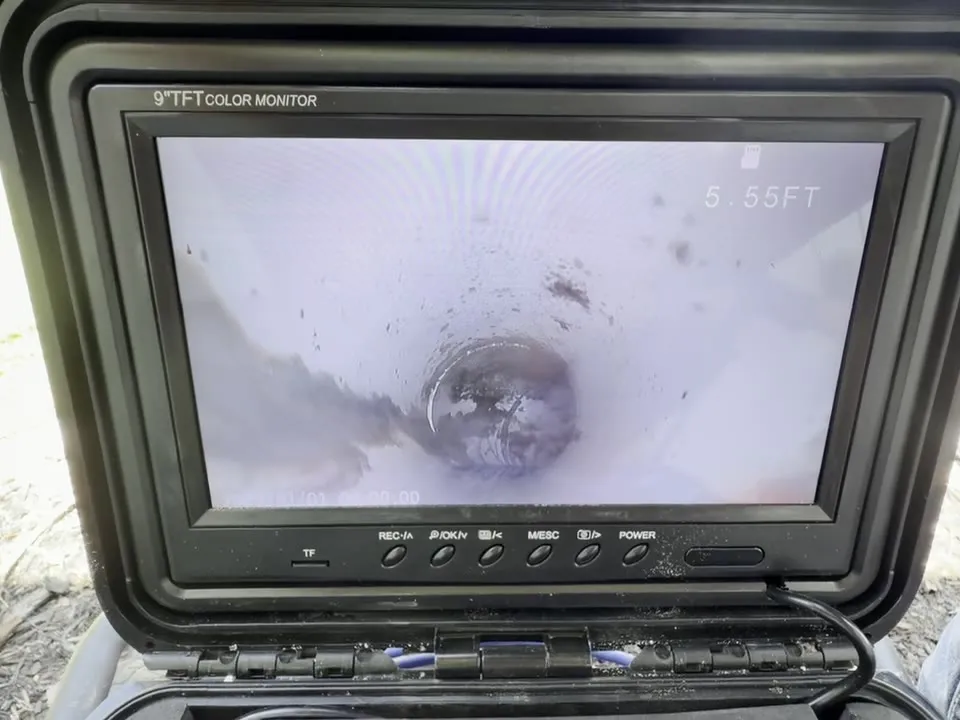
We push a camera on a stiff cable through the pipe and watch the screen as it travels. The camera head carries a signal, so when we spot the problem we can stand in the yard with a locator and mark the exact spot and how deep it is.
Then we tell you what we saw, in plain words. A belly is a low spot where the pipe has sagged and water sits. Root intrusion is tree roots growing in through a joint or a crack. A separated joint means two sections of pipe have pulled apart. A crushed section speaks for itself.
You get an honest read before we leave: what it is, where it is, and what fixes it. If it is a clog or roots, jetting may be the whole answer. If the pipe is broken, we tell you the repair, and we can do that too. No runaround, and no digging until you have seen the picture.
What affects the job here
The water table. For much of the year, and through most of the wet season (roughly June to October), the ground in Southwest Florida is saturated. The camera will often show water standing in the line. That can be normal when the drain field is soaked, or it can be a belly. We tell you which.
The soil. Our ground is sand over limestone and shell. Sand moves. A pipe laid straight can settle into a low spot after years of wet and dry seasons, which is why bellies are one of the most common things we find in this region.
Older pipe. Older homes here often still run on cast iron or clay. Cast iron rusts from the inside, and the bottom of the pipe goes first, so the camera can show a channel where the floor of the pipe used to be. Clay pipe has joints every short section, and roots find them.
Sewer conversion. Parts of Lee and Collier counties are moving from septic to sewer, while Lehigh Acres and parts of Cape Coral stay largely on septic. If your property is being connected, a camera run on your side of the line first shows whether the pipe is fit to connect or needs work before the tie in.
Homes, businesses, or both
Homeowners. This is the step before anyone digs, and it usually saves the yard. You see the screen with us, and you decide what happens next.
Businesses. Restaurants, property managers, builders and contractors call us to check a lateral before a buildout, to find out why the line behind the grease trap keeps backing up, or to know the condition of a line before a new tenant moves in. One call and it is handled.
Municipal. A city or county crew calls for a camera when a section of sewer main, a storm line, or the pipe feeding a lift station (the pumped pit that moves wastewater uphill) keeps needing service and they need to know why. We mark the spot and the depth on the ground so the repair crew digs once.
Call the office at (239) 225-2255, day or night. It is our direct office line, a real person answers, and we will get you on the schedule.
Common questions
Do you have to dig to run the camera?
No. The camera goes in through a cleanout or the tank opening, so nothing gets dug up just to look. If the camera finds a break that needs a repair, we mark the spot and the depth so any digging is small and in the right place.
Can the camera get through a clog?
Not usually. If the line is packed with grease, roots or debris, we jet it first, then run the camera so we see the pipe wall and not the blockage. Both can happen on the same visit, and we tell you before we start.
Will a camera inspection tell me if my septic tank is failing?
It tells you about the pipes, not the tank itself. For the tank, the baffles (the fittings that keep solids inside the tank) and the drain field, ask for a septic inspection. On a home sale, many buyers ask for both at once.
Should I get a camera inspection before buying a house on septic?
It is not required, but it is the only way to know what the pipe between the house and the tank looks like. A pump out and a camera before closing means the seller fixes problems, not you. Ask for the point of sale septic inspection at the same time and we will do both.
Do you camera sewer lines, or only septic lines?
Both. If the property is on city sewer, we run the camera from the house to where your line meets the main and find the problem. If it is on septic, we run it from the house to the tank, and from the tank toward the drain field.