
SINCE 2010
Grading and excavating in Southwest Florida
A septic system is mostly earthwork. Before a tank goes in, the lot has to be cleared, the hole dug to depth, and the fill brought in, and after it is set the yard has to be shaped so rain runs away from it. We do that work with our own excavators, track loaders, and dump trucks, run by our own operators, for homeowners and businesses across six Southwest Florida counties. Call the office to talk through your site, and a real person answers.
When you need it
You are building on an unsewered lot, and the septic system has to be laid out and dug alongside the rest of the site work. The lot is overgrown, and the spot the permit drawing shows for the tank and the drain field is still brush and palmetto.
An old drain field has failed and has to come out. The spent soil is dug away, new fill comes in, and the new field is built on top of it.
The permit calls for a mound. The water table on your lot is too close to the surface for a field at natural grade, so the field has to be raised on imported sand, and somebody has to haul it in and shape it.
Water stands over the tank or the drain field after every storm, because the yard around it slopes the wrong way.
A ditch runs along the front of the lot and the driveway has to cross it, or the old culvert under the drive has collapsed or filled in. That takes a culvert: the pipe that carries the water under the crossing, set so the ditch keeps flowing.
If any of that is your situation, call the office and tell us about the lot.

What we do on the visit
Most of this work is part of a larger septic job, so it follows the permit drawing. We stake out where the tank, the lines, and the drain field go, and where the machines can come in without crossing anything that has to stay.
Clearing comes first. The excavator pulls the brush, roots, and stumps out of the work area so the dig starts in clean ground.
Then the hole. The tank excavation goes to the depth on the drawing, with the walls kept stable and the bottom level so the tank sits flat. For a drain field, the bed is dug out and the unsuitable soil comes out with it.
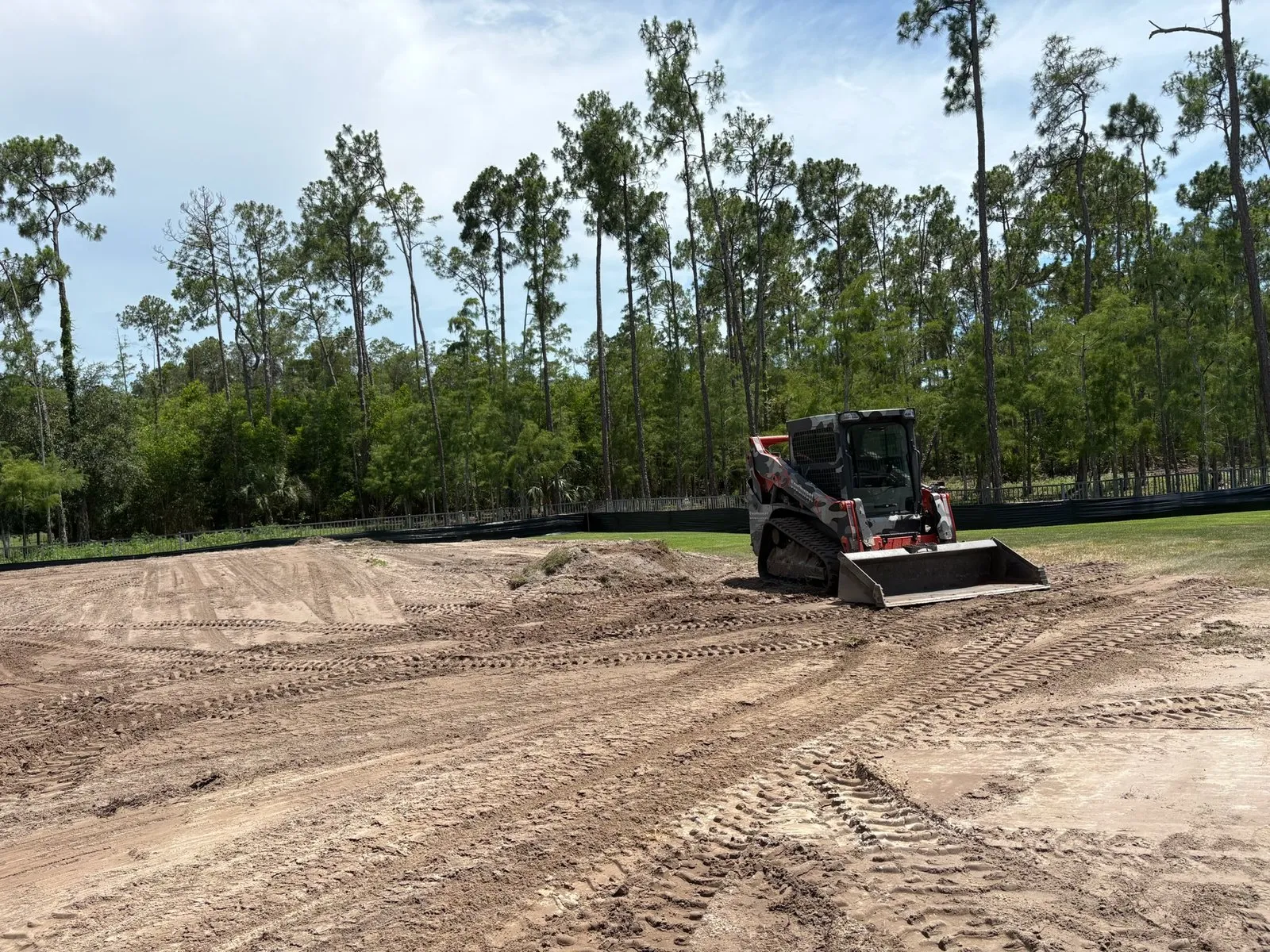
Fill comes next. The dump trucks bring in the sand, and the track loader spreads it in layers to the height the design calls for. On a mound, that height is the whole point of the system.
Last, the grade. Once the system is set and inspected, the cover goes on, the shoulders are shaped, and the surface is left sloping away from the tank and the field, so rain runs off instead of soaking in on top of them.
A culvert is its own job. The crossing is dug out, the pipe is set in line with the ditch, and the fill goes back over it in layers so the drive can carry a car.
What affects the job here
Water is in the way most of the year. Dig a few feet down in much of Southwest Florida and the hole starts filling, more so in the wet season, roughly June to October. The crew plans for it, keeps the excavation stable, and pumps it down when the work needs a dry bottom.
The soil is sand over shell and limestone. Sand digs fast but caves easily, and a rock layer partway down can stop a bucket cold. Knowing what is under a lot before the tank arrives saves a second trip.
Grade matters more on a flat landscape. With little natural slope, a small low spot over a drain field can hold rain for days and keep the field from drying out. Getting the final shape right is part of keeping the system working.
Homes, businesses, or both
All three. For homeowners, this is the clearing, digging, fill, and final grade on a new system, a drain field replacement, or a repair that needs the ground opened up, and the culvert under a driveway.
For businesses, builders, and property managers, it is the same work on a larger footprint: the earthwork for a commercial system, a grease interceptor, or a lift station, with the excavation, the hauling, and the grading handled by one company. We have worked out of Fort Myers since 2010, licensed under SR0181834 and SR0101645.
For cities and counties, grading means shaping the ground at a public site so rainwater runs where it should: part of a larger site plan, or a focused fix where water keeps standing.
Common questions
Do you hire out the digging on a septic job?
No. The machines on the site are ours and so are the people running them. The crew that digs the hole is the same crew that sets the tank and lays the drain field, so nobody is waiting on another company to show up.
Why does a drain field need so much fill sand here?
Because the ground water sits close to the surface for much of the year. A drain field needs a layer of unsaturated soil under it to treat the water, and on a lot where that layer is too thin the field has to be built up. That is what a mound system is.
Will the yard look torn up when you leave?
The last step on the job is final grading: the spoil is spread or hauled off, the cover is shaped, and the surface is left smooth so it can be sodded or seeded. Tell us what you plan to plant and we will leave the grade ready for it.
Can you grade around a system that is already in the ground?
Often, yes. Low spots that hold water over a tank or a drain field, or a slope that sends a neighbor's runoff across it, can be reshaped. The crew works out where the lines run first, so the machine stays off them.
Do you do excavation that is not part of a septic system?
Culverts, yes, and grading for cities and counties. Otherwise our earthwork goes with septic systems. If you are not sure which side of that line your job falls on, call the office and a real person will tell you.