
SINCE 2010
Septic tank pumping in Southwest Florida
Drains slow, a smell in the yard, or just due for a pump out? We pump and clean septic tanks for homes and businesses across Lee, Collier, Charlotte, Hendry, Glades, and DeSoto counties. Call the office. It is our direct line, and a real person answers, day or night.
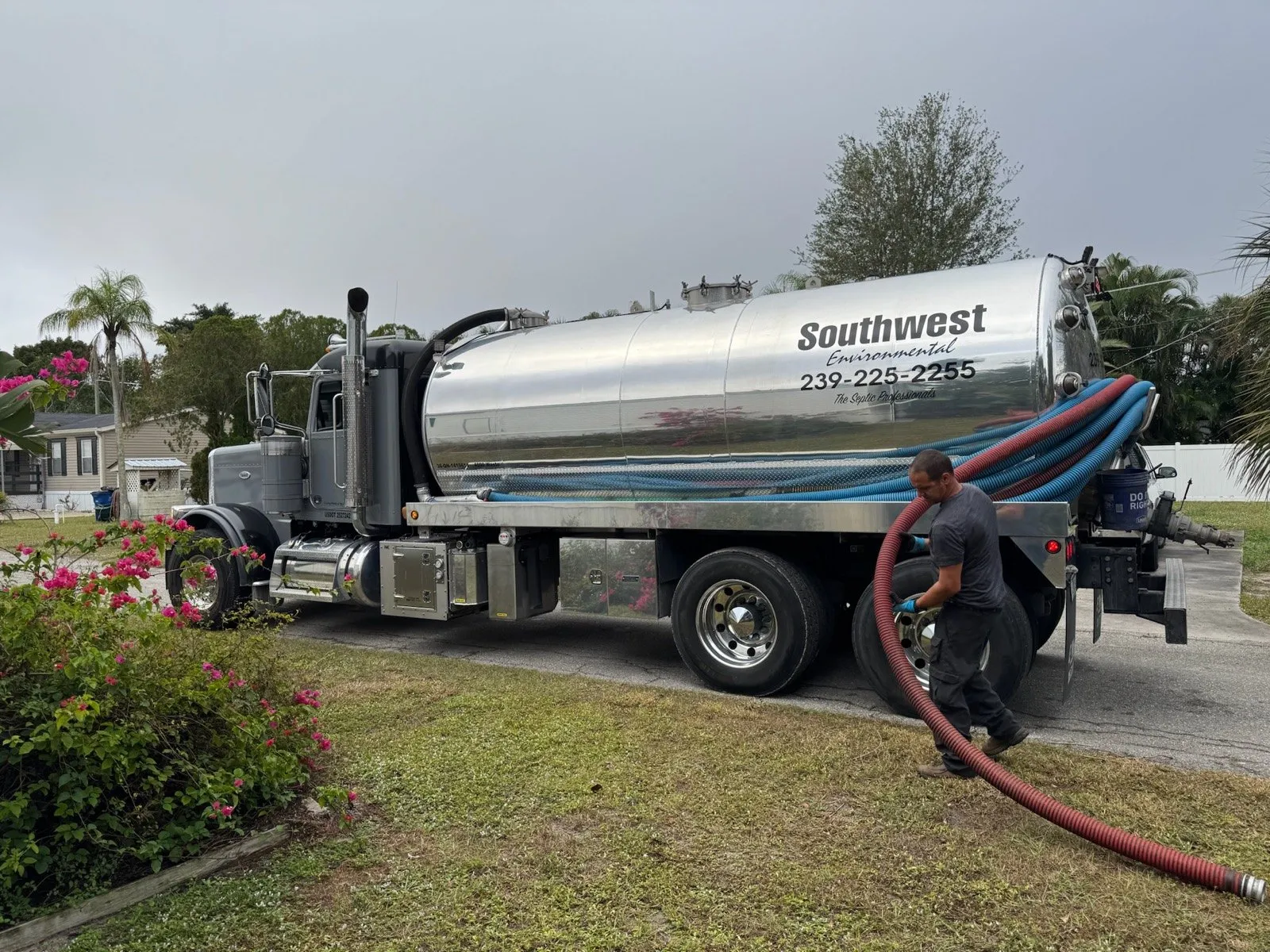
When you need it
Most calls for a pump out come for one of two reasons. The tank is on a schedule and the date has come up, or something in the house has changed and you want to know why.
The signs are hard to miss once you know them. The toilet gurgles after a load of laundry. The shower drains slow and the tub holds water. There is a soft, wet spot over the tank or out in the yard, and a smell that was not there last month.
Sometimes the warning is a piece of paper, not a puddle. A sale is pending and the buyer wants the tank pumped and looked at. A tenant is moving out and the next one is moving in. Or you bought the house and nobody can tell you when the tank was last serviced.
If sewage is coming up in a tub or a floor drain, that is a backup, not a maintenance question. Call the office at (239) 225-2255 right then. We offer 24/7 emergency service, and a real person answers.

What we do on the visit
First we find the tank. If yours has a riser, a short pipe that brings the lid up to grass level, the crew opens it. If not, we locate the lid and dig down to it.
Before the hose goes in, we look at the liquid level. A working tank sits at the level of its outlet pipe. Water above that line points to a drain field that is not taking water. Water below it points to a leak. That one look tells us a lot.
Then we pump. A septic tank holds three layers: scum that floats on top, liquid in the middle, and sludge that settles on the bottom. Pumping means all three come out, not just the liquid. The crew breaks up the crust and the sludge so the hose can take it, and works both compartments if the tank has two.
With the tank empty, we check the baffles. Baffles are the fittings on the inlet and outlet pipes that keep the floating layer inside the tank and out of your drain field. A missing or broken outlet baffle is one of the most common things we find, and it is a small fix next to the drain field it protects.
We also look over the lid, the riser, and the tank walls for cracks and roots. Then we close it up, put the dirt and sod back, and tell you what we saw in plain words. No runaround, and an honest price on the visit.
What affects the job here
Septic is a little different in Southwest Florida, and a pump out here has a few local wrinkles.
The water table is high for much of the year and highest in the wet season, roughly June to October. In those months the drain field can sit in saturated ground for weeks. If your tank is running high, the field may simply have nowhere to send the water. Pumping brings relief, but it is worth knowing why the level was up.
Wet ground matters for the tank itself, too. An empty tank in saturated soil can shift or lift, and a plastic or fiberglass tank is more at risk than a concrete one. The crew checks the site before pumping a tank dry. Once in a while the smart move is to wait a few days for the ground to drain, and we will say so.
Our soils are mostly sand over limestone and shell. Sand drains fast in the dry season and slow in the wet. It also makes finding and uncovering a lid quick work on most lots.
Pumping itself does not need a permit. Installing or replacing a system does, and since 2021 those permits come through the Department of Environmental Protection, still handled at the county office. We hold licences SR0181834 and SR0101645, and we have been doing this work here since 2010.
Parts of Lee and Collier counties are moving from septic to sewer, while Lehigh Acres and parts of Cape Coral remain largely on septic. If your street is on a conversion list, the tank still needs routine pumping until the day you connect, and it has to be pumped and closed properly when you do.
Homes, businesses, or both
Both. Pumping is the job we do most, for houses and for businesses.
For homeowners it is mostly routine. We set a schedule that suits your tank and how many people live in the house. If you would rather not think about it, we can set the next date in advance so the work happens before the problem does.
For businesses it is about staying open. A restaurant, an office, or a rental on septic cannot have the tank back up in the middle of the day. Property managers get one number for every property on their list. Builders and contractors call us to pump a tank down before a repair, a replacement, or a closing.
Restaurants on septic usually have a grease trap as well, a tank that catches kitchen grease before it reaches the septic system. We service those too, on a schedule that suits the kitchen.
Whichever door you come in through, the number is the same. Call (239) 225-2255. It is the direct office line, we do not use tracking numbers, and a real person answers.
Common questions
How often should a septic tank be pumped?
The usual rule of thumb is every three to five years, but that is only a starting point. A small tank, a full house, or a garbage disposal all fill it faster. Call the office and we will set a schedule that fits your tank and the people using it.
I do not know where my tank is. Can you still pump it?
Yes. The crew traces the line out from the house, probes for the lid, and uncovers it. If the lid sits deep, ask about adding a riser, a short pipe that brings the lid up to grass level, so the next visit is quicker.
Do I need to be home for the visit?
Not always. The crew needs to reach the tank and get the truck close to it, so leave the gate unlocked and the driveway clear. If you want to walk the yard with us and ask questions, we are glad to have you there.
The tank was full to the top when it was opened. Is that bad?
A tank is meant to sit at the level of its outlet pipe, so a tank at that line is normal. Water above the outlet means the drain field is not taking it, and that is worth a closer look. We will tell you what we see on the visit and what the next step is.
Can you pump a tank during the rainy season?
Yes, with care. In the wet months the ground around the tank can be saturated, and an empty tank in wet ground can shift or lift. The crew checks the site and the tank type first, and if it is wiser to wait a few days, we will say so.
Do additives mean I can skip pumping?
No. Additives can help a healthy tank between services, but nothing takes the solids out except a pump truck. Think of them as a supplement to pumping, not a replacement for it.